
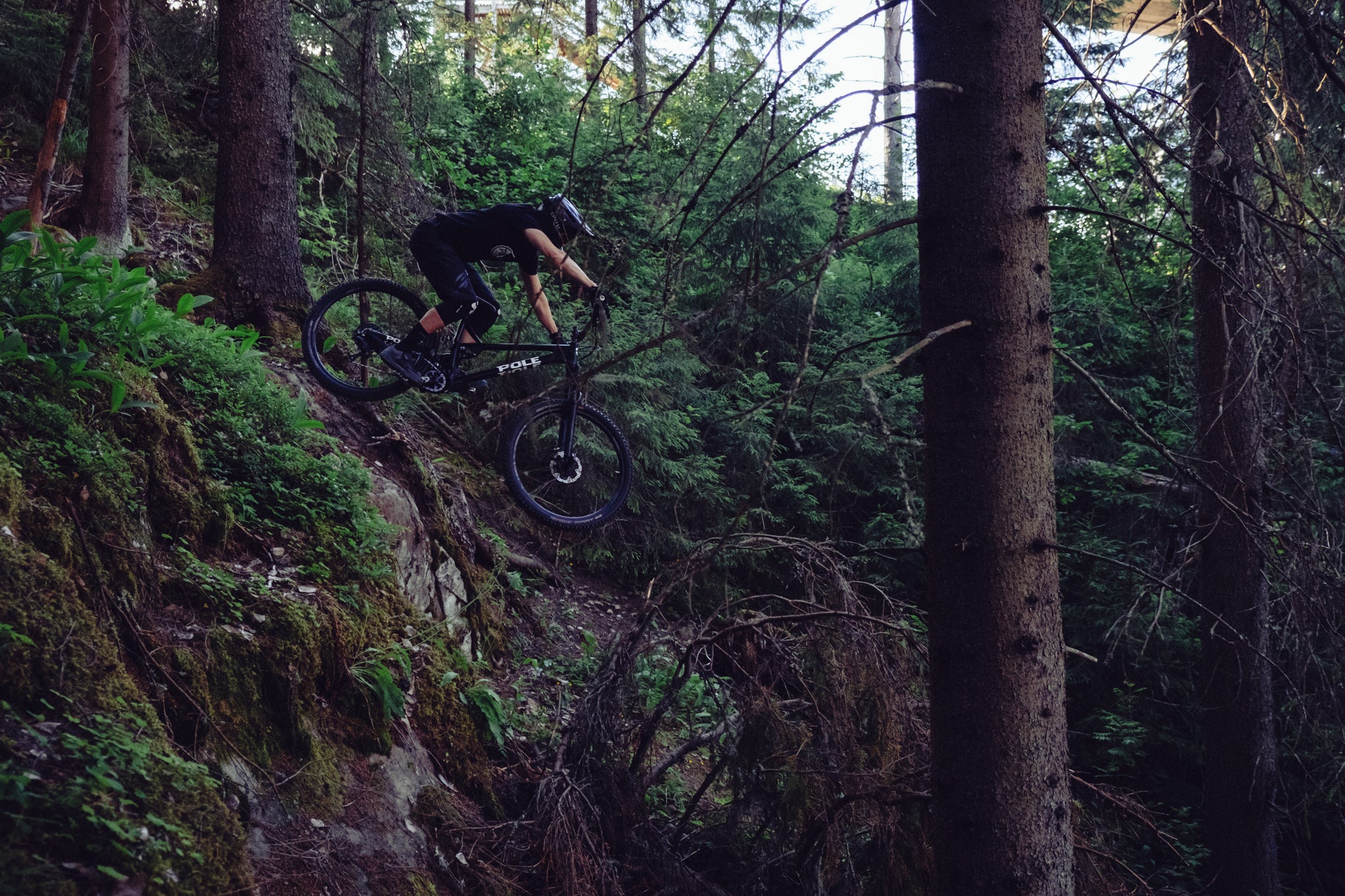
EVOLINK 140
The original game changer. 64.5° head angle and 77.5° seat tube angle when the industry was still arguing whether 67° was too slack.
A bike built for how people actually ride, not what the spec sheet said they should want.
The problem
In 2015, most trail bikes had 67° head angles and 73° seat tubes. They climbed fine on mellow fireroads and understeered on anything steep. Leo Kokkonen had been testing radical geometry on a modified K9 DH001-S mule since 2013 and a BTR proto in 2014 — he knew what would work on real trails. The EVOLINK 140 was the first time those numbers shipped as a production bike.
The numbers
64.5° head angle. 77.5° seat tube angle. A wheelbase that looked absurd on spec sheets and felt obvious the moment you rode it. The bike climbed better than it had any right to, and descended like it was cheating. Welded 6061 aluminum frame built in Taiwan, specced with 27.5" wheels and 140mm rear travel.
The reaction
The industry called it extreme. Then, one by one, every major brand moved toward the same numbers. Today 64° head angles are normal on enduro bikes. 77–78° seat tubes are standard. The EVOLINK 140 didn't start that shift alone — but it was the first production bike willing to ship it.
It's hard to overstate how ahead of its time the Evolink was.
In 2024 Pinkbike revisited the 2016 EVOLINK as part of their retrospective series — a tacit acknowledgment that the geometry Pole shipped in 2016 became the template the rest of the industry followed.
GALLERY
The frame that moved the industry.