MANUFACTURING
Machined from solid.
From solid aluminum to your frame. Machined, bonded, and finished — one at a time.
50 frames in 2026. Each one machined to order.
There is no warehouse. No batch production. Every Hiisi frame is machined after the owner's consultation is complete and the specifications are confirmed. The manufacturing process that follows is the same for every frame — precise, controlled, and verified at every stage.

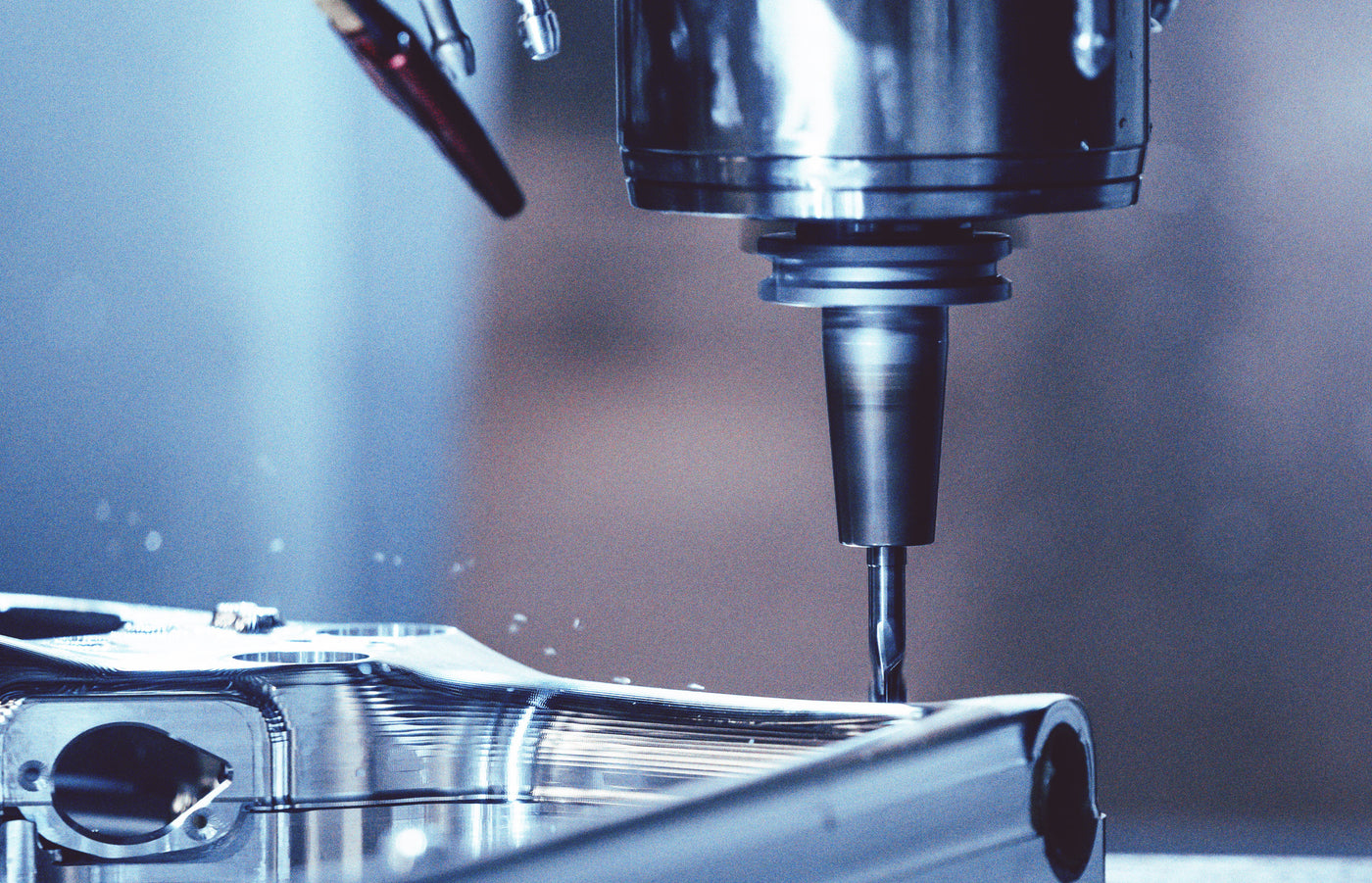
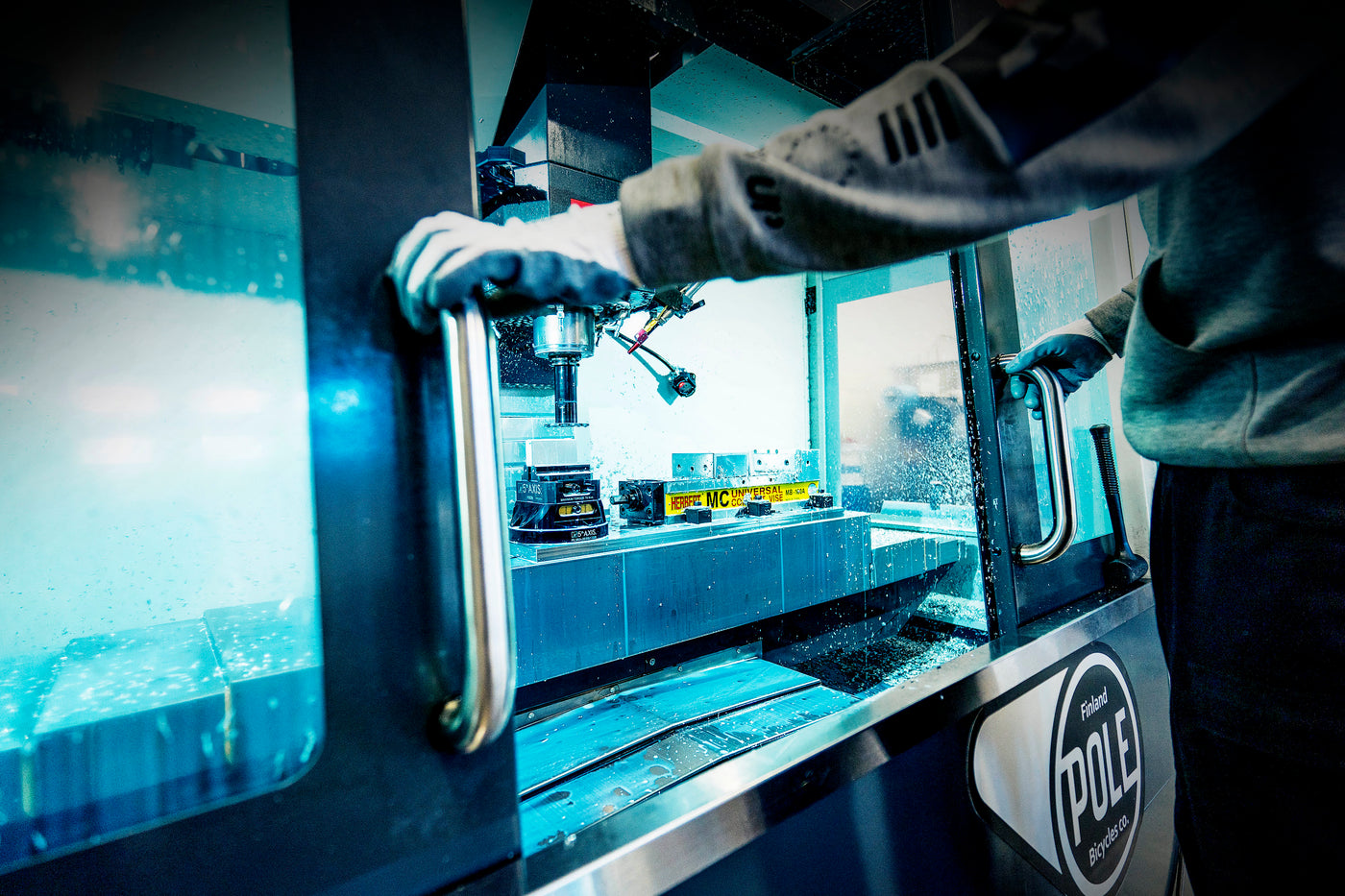
CNC MACHINING
We machine the most precise bicycle frames in the world. That's not marketing.
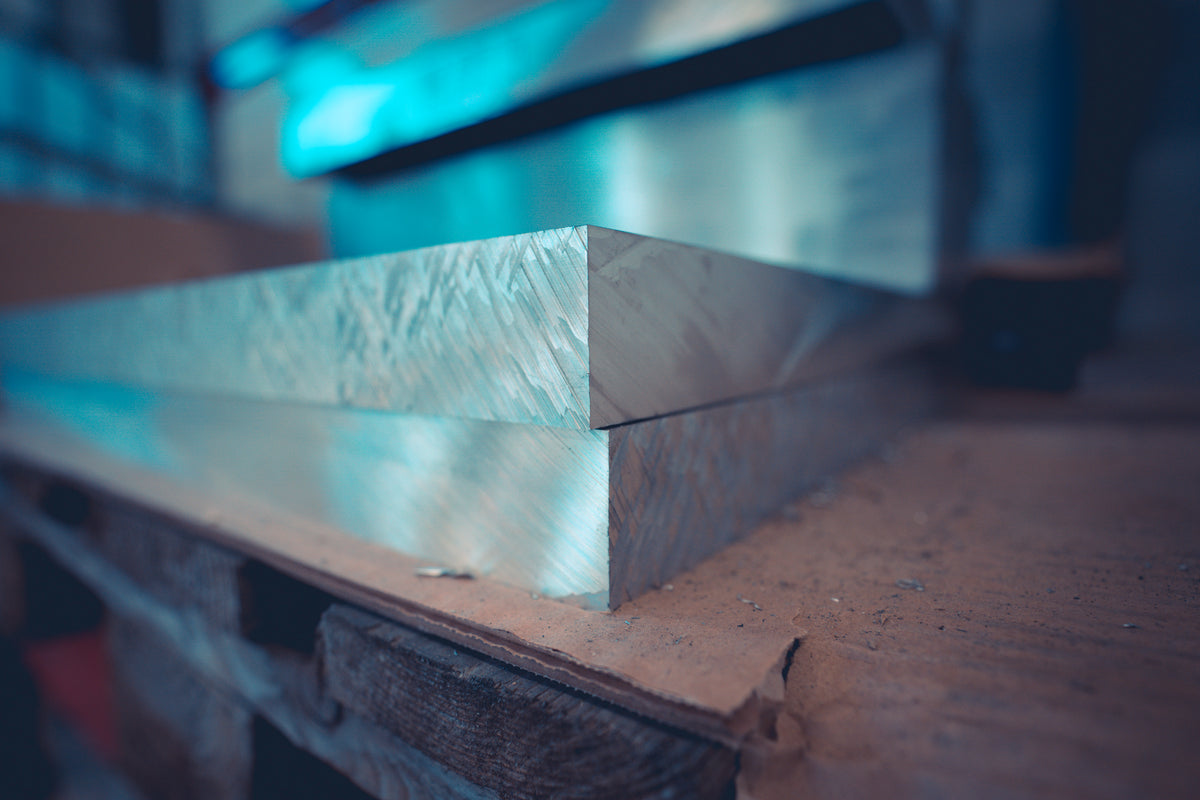
24 hours of CNC machining. 100 kg of aluminium becomes a 3 934 g frame. When the manufactured geometry matches the CAD model within ±0.05mm, every simulation, every kinematic curve, every structural analysis is real — not an approximation. Precision is not a feature we added. It's the foundation everything else is built on.
Wall thickness control
Every wall in the Hiisi is individually optimized. Stress-bearing areas are thicker. Low-stress areas are lighter. CNC allows continuous wall thickness variation across the entire frame — material is placed exactly where load analysis requires it.
Pivot precision
Pivot bearings operate within ±0.05mm of their designed position. The kinematic simulation matches real-world behavior — the anti-squat and leverage curves on the Platform page are not theoretical. They're measured.
Structural predictability
FEA is only as good as the model it simulates. When every dimension of the manufactured part matches the CAD file, the analysis validates the actual product — not a best-case scenario. Every stress path, every fatigue calculation is real.
Repeatable manufacturing
Frame #1 and frame #50 have identical dimensions. No process drift. No jig wear. No operator variation. The structural validation applies to every frame we ship, not just the prototype.
Aerospace adhesive. Seven-stage process.
Structural adhesive bonding is the standard joining method in aerospace and Formula 1. It distributes load across the entire joint surface — unlike mechanical fasteners that concentrate stress at discrete points. Our bonding process follows aerospace surface preparation standards, adapted and refined for bicycle frame production over several years.
The process
Each frame half is CNC-machined to tolerances tighter than ±0.05mm. After quality inspection, the bonding surfaces go through a controlled preparation sequence:
1. Solvent degreasing bath — removes all machining oils and contaminants.
2. Acid etch — sulfuric acid removes a thin layer of surface material, eliminating embedded impurities and creating a controlled surface profile.
3. Passivation — the parts are dipped to deposit a thin protective film that shields the bond interface from corrosion for the lifetime of the frame.
4. Adhesive application — aerospace-grade structural epoxy is applied to the prepared surfaces.
5. Assembly — the frame halves are pressed together under controlled pressure.
6. Curing — the epoxy is cured into its final structural state.
7. Final inspection — every bonded frame is verified before proceeding to surface treatment.
The adhesive
We use a structural epoxy developed for aerospace primary structures. It delivers exceptional shear and peel strength, high impact resistance, and long-term stability across a wide temperature range. The adhesive maintains its structural integrity under exposure to chemicals, moisture, and temperature cycling — conditions that a mountain bike frame encounters throughout its life.

Invisible to the eye. Patented by Pole.
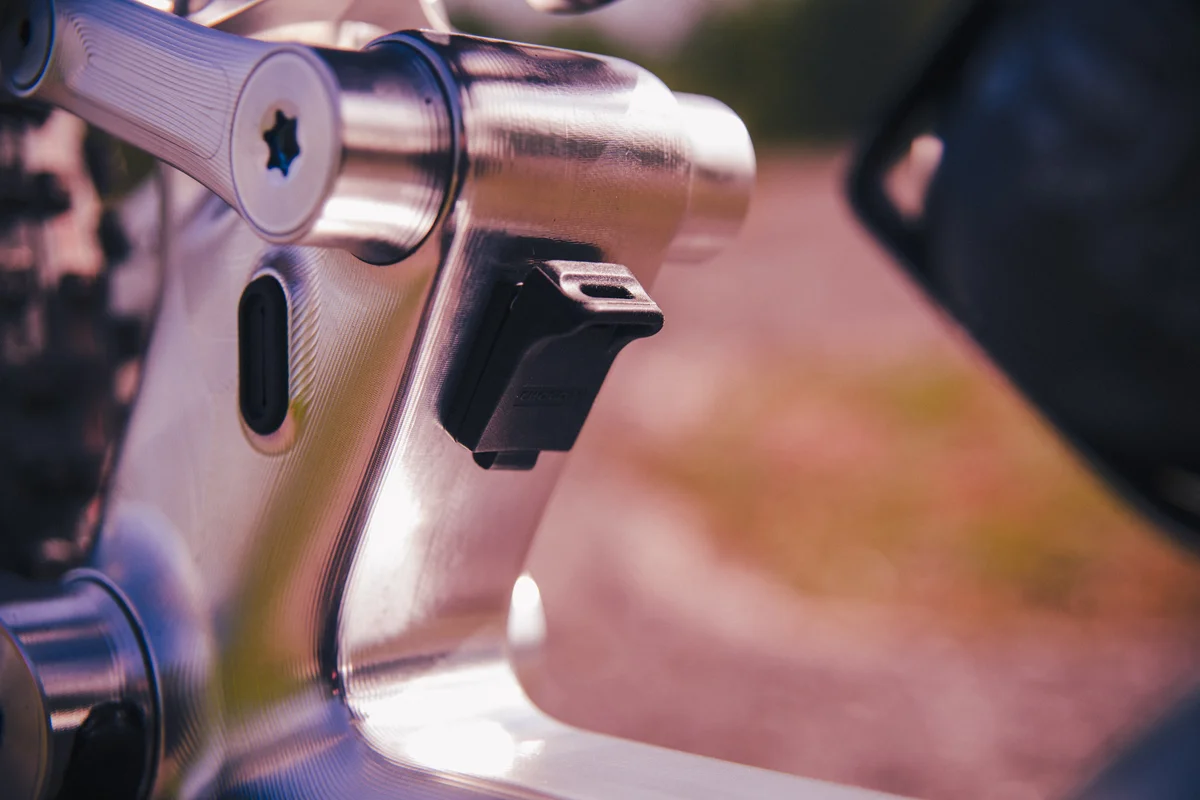
The Hiisi frame is bonded from two machined halves. The seam between them is invisible to the naked eye.
A patented technique
This is not cosmetic. The invisible seam is a patented structural feature that improves both the quality and durability of the frame. We have developed this technique over several years of iteration — refining the joint geometry, the surface preparation, and the fit tolerance until the two halves meet as one continuous surface.
Beyond adhesive
The latest generation of the Hiisi adds mechanical reinforcement to the bonded joint — making the connection even stronger than adhesive alone. But not in the conventional way. Mechanical fasteners concentrate stress at their insertion points, creating localized strain that can propagate through the structure — similar to how a weld heat-affected zone weakens the surrounding material.
We developed a method that reinforces the joint without introducing parasitic stress. The frame remains free from the internal tensions that degrade structural integrity over time.
The e-coat protects. The finish expresses.
Electrophoretic coating
The entire structure receives an electrophoretic coating (e-coat). The frame is submerged in a charged bath that deposits a uniform, corrosion-resistant layer across every surface — including internal cavities and areas that spray application cannot reach.
E-coating is the same base protection used in automotive manufacturing. It provides consistent coverage regardless of geometry complexity, and it bonds to the aluminum at a molecular level.
Final finish
Three e-coat finishes — Raw Silver, True Gold, Hero Bronze — each applied in-house. No paint. Every toolpath remains visible through the surface. The finish you choose is part of the machine's identity.
Every frame. Every dimension.
Dimensional verification
Every machined part is measured against the CAD model before bonding. Every bonded frame is measured again before surface treatment. Pivot locations, bearing bores, and critical interfaces are verified to ensure the kinematic design performs as intended.
50 frames, 50 inspections
With a production of 50 frames per year, every unit receives individual attention. There is no sampling, no statistical quality control. Every frame is inspected as if it were the only one we build — because for its owner, it is.
Continue
You've seen how it's made. Now make it yours.