

PRESS RELEASE · JYVÄSKYLÄ · 28 APRIL 2026
Pole Hiisi
Pole's first Adaptive Platform bike. 152 to 200 mm of rear travel from one CNC-machined frame, in 29" or Mullet wheel configurations, in three frame sizes — twelve configurations in total. Fifty units for 2026, built to order in Jyväskylä.
PRESS KIT
Press kit
Press release as PDF, geometry + kinematics as a live Google Sheet (the source-of-truth chart with all configurations and curves), and a ZIP of all hi-res photos for press use.
Pole has launched the Hiisi, the first bike in the company's new Adaptive Platform category — a CNC-machined e-MTB built around one frame that covers 152 to 200 mm of rear travel across twelve configurations.
Pole will build fifty units for 2026, each specified to the rider who ordered it, at the company's factory in Jyväskylä.

One frame, four travel lengths, two wheel setups
Travel options: 152, 173, 180 or 200 mm at the rear. Wheels: Full 29" or Mullet (29" front, 27.5" rear). Frame sizes: K1, K2 and K3, fitting riders from 155 to 198 cm.
Static head and seat angles slacken progressively as travel increases. Dynamic ride height at sag is engineered to remain consistent across wheel configurations: a 173 mm Full 29" build and a 173 mm Mullet build sit at the same effective height on the same frame. The platform achieves this without flip chips, eccentric inserts, or interchangeable links.
Reconfigurable across the bike's lifetime
Because the chassis covers 152 through 200 mm without a frame swap, configurations are not fixed at purchase. A 2026 build at 173 mm Full 29" can be reconfigured to a 200 mm Mullet setup in 2027 with a parts change. Geometry across all twelve configurations has been engineered into the same frame.

Electric only for 2026, with a Manual Converter kit
For 2026 the Hiisi ships as an e-MTB with a Maxon Air S motor and 600 Wh battery. A Manual Converter kit is sold separately: removing the motor and battery and fitting an adapter and standard crankset returns the chassis to analog drive. The kit is intended for riders who require a non-electric configuration for race regulations or travel restrictions.
Four generations of platform development
The 2016 Evolink came in 110, 131, 140, 158 and 176 mm versions, each on its own welded frame. Stamina (2018) was Pole's first chassis to cover more than one bike, sharing a frame between 180 and 160 mm with a yoke change. Voima/Vikkelä (2021) and Onni/Sonni (2023) extended the modular approach. The Hiisi is the fourth iteration and the first to cover the full 152–200 mm range from a single chassis.

Machined, not welded
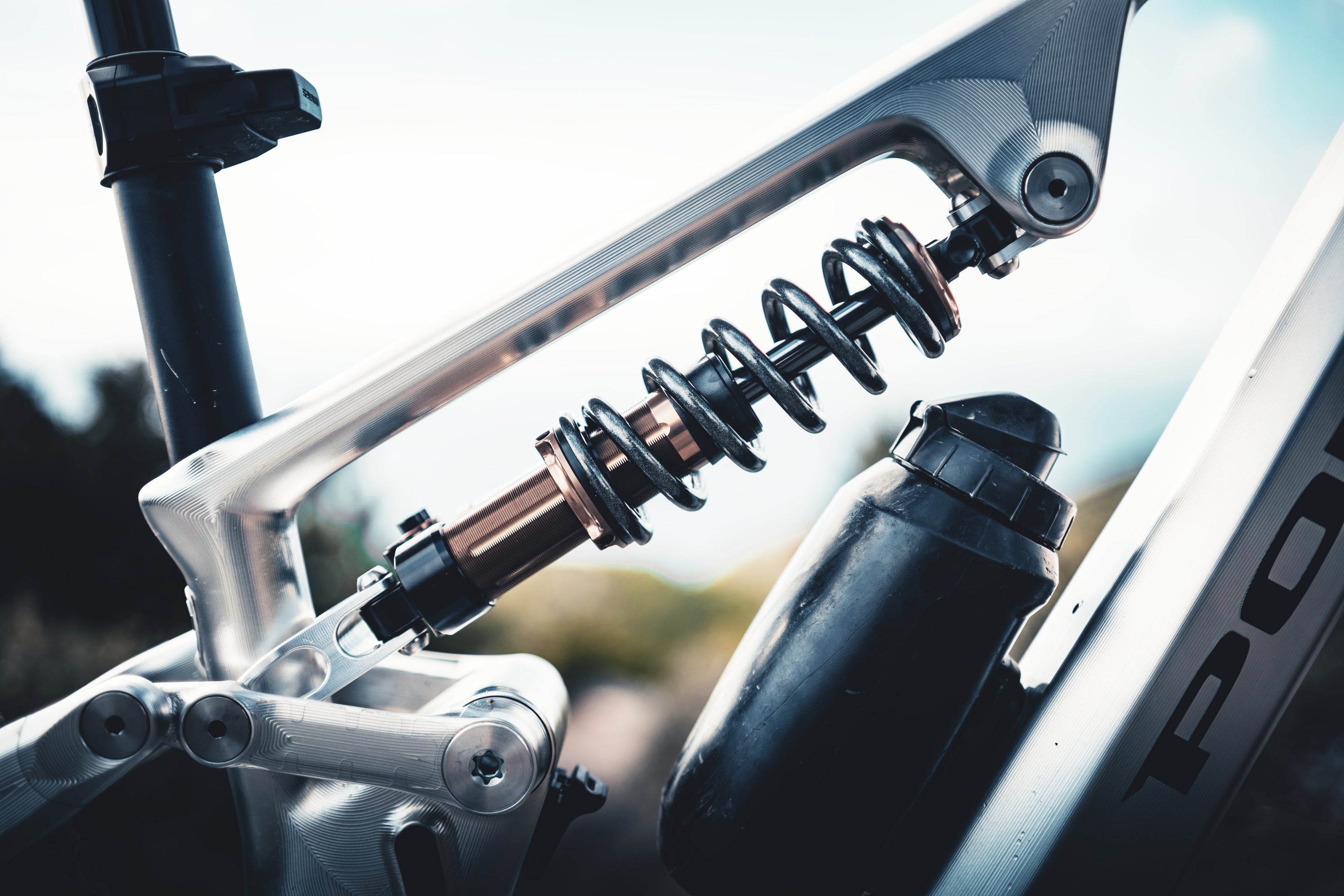
The frame is CNC-machined from solid aluminium. Bearing surfaces and pivot points come out of the same setup, in the same operation. Wall thickness is controlled all the way through the chassis — not approximated by which extruded tube happened to be available.
Bonded and joined
Pole has refined a bonded-and-mechanically-joined construction since the 2017 Machine. Components are CNC-machined individually, then bonded and pinned into the chassis. The construction allows precision control at every joint, independent of welding tolerances.
Finished in-house
Three e-coat finishes — Raw Silver, True Gold, Hero Bronze — applied at Pole's factory in Jyväskylä. No paint. The toolpaths are visible through the surface; that's the point.
Amplifies, doesn't override
The Maxon Air S amplifies the rider's input rather than overriding it. Pedal harder, the bike pedals harder. Ease off, it eases off. Three support modes — Cruise, Sport, Blast — tune the response, but across all three the motor reads pedal stroke and matches it. No surge, no lurch, no motor whine.
How the range extender works
The Maxon Air S system uses an unusual range-extender topology. The bike runs on the main battery (400 or 600 Wh). The optional 250 Wh extender doesn't power the motor directly — it trickle-charges the main battery while the rider rides, whenever the main has room to receive. The rider stays on the main pack, full power, all the way down. If the extender empties, the bike runs as it always did. If no extender is fitted, the bike runs as it always did. It's Maxon's design; Pole picked it deliberately.
Why Maxon
Maxon (Sachseln, Switzerland) has been engineering precision drives since 1961. Their motors flew on every Mars rover from Sojourner to Perseverance, and on Ingenuity, the first helicopter on another planet. They power surgical robotics and insulin pumps. The Air S is what happens when that engineering culture turns to a bicycle. We picked Maxon because they've been building motors for places where motors can't fail.
"Stamina was where one frame first covered two travel lengths. Voima and Onni each pushed it further. Hiisi is the first time we got the whole range — 152 to 200 mm — out of one chassis. That's what we mean when we call it an Adaptive Platform. It's what we've been working towards the whole time."
— Leo Kokkonen, founder
PRESS IMAGES
Use these with a credit to "Pole Bicycles".
Press contact
Hi-res images, factory access, technical detail, or interview time on request.
Leo Kokkonen
leo@polebicycles.com
+358 50 370 0241 (call, WhatsApp, Signal)
Pole Bicycles is trading as Mahtisonni Oy · Business ID 3444291-5 · Jyväskylä, Finland
Progressive leverage is deliberate. High initial ratio means sensitive small-bump response. The progressive drop through mid-stroke provides support for pedaling and cornering. At full travel, the falling ratio resists bottom-out without harsh end-stroke. Click each configuration above to see how the curve adapts to its intended use.
| K1 | K2 | K3 |
|---|